Category: Uncategorized (Page 1 of 2)

Learning Outcome 4 (Peer Review)


Peer review has been extremely beneficial to my final drafts of essays. Unlike my peer review in high school which focused on grammatical errors and sentence structure, peer review in college helps with ways to make your essay better by using global revision which is big picture stuff such as organization, paragraph structure, arguments, and evidence as well as local revision which is the way you manage your sentences to enhance specificity or clarity. When reviewing with my peers this semester I was offered to bolster my argument like adding more specificity to an example, making my thesis statement clearer, or adding more analysis after a quotation. Having someone to work with wasn’t only beneficial because of the comments they left on my essays but by being able to read their work I was able to see what worked well for them and tweak their style into my own essay. Whether it was their play on words or their uses of examples to pull me in, I feel that a lot of the growth I have undergone this semester has been through peer review. It pushed me to slow down, rethink why certain choices mattered, and become more intentional with how I present my ideas. It also helped me see my writing from a reader’s perspective, which made my revisions more purposeful and less about fixing mistakes and more about shaping meaning. Overall, peer review has become one of the most important tools in improving how I write and how I think about writing.

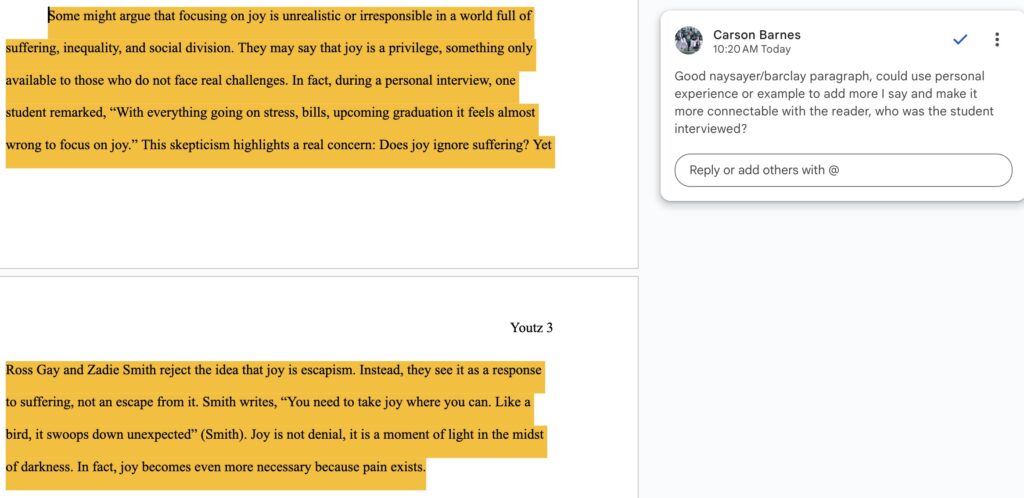
Comment left on my peer’s essay to inspire more I say. The peer did a good job using sources to create their Barclay/Naysyayer paragraph but I felt they need to include their own voice to make it more compelling.
End Comment left for my peer during the Joy essay peer review session. By giving a brief overview on what I thought they did well and gave them my own insight on what they could improve on I feel as I was able to set them up to improve on their essay as well as boost their confidence on what they did well.

Learning Outcome 3 (Reading + Annotations)

Revisiting my responses from “The Hawk” by Brian Doyle and “Joy” by Zadie Smith, I was disappointed and pleased with myself. Why both? You might ask. Well I am disappointed in the way I used to answer questions, clearly lacking specificity. I would answer the questions with a summary rather than analyzing the questions and using my own voice. However, I am pleased with how far I have come since then. More recently, my answers in response to “Joy” offer more detail and analysis of the piece. Answering the questions with my own voice and quotes from the source, rather than a brief summary. During the first essay it was difficult to gather my ideas to support my argument, but by writing in more detail and using critical thinking in my responses I was able to transfer over some of my ideas easier during the second essay. Not only have I noticed a difference in my responses but I have developed my annotation skills tremendously. Annotation being a key difference in my writing process between essay one and two. When I first began with Becoming a Writer, I would circle or write in the margin when I noticed something, causing my annotations to not be scattered all over the place. Now, after learning about different annotation styles such as understanding, rhetorical, questioning, and exploring relationships, I am able to think more critically about what I am reading. Using those annotation styles allows me as a reader to bookmark key information for reading responses and contribute more to class discussions.

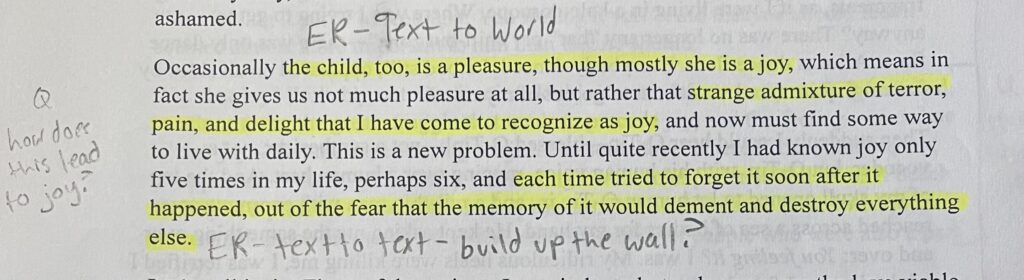
Annotation 1: Uses both Text-to-World and Text-to-Text annotations to explore relationships. The text-to-world annotation is used when I recognized how a child brings joy to many families in our world. The text-to-text is used when I noticed a similarity to Brian Doyles idea of “building up a brick wall”. Uses questioning annotation to bring up in class: How the paragraph leads to joy?
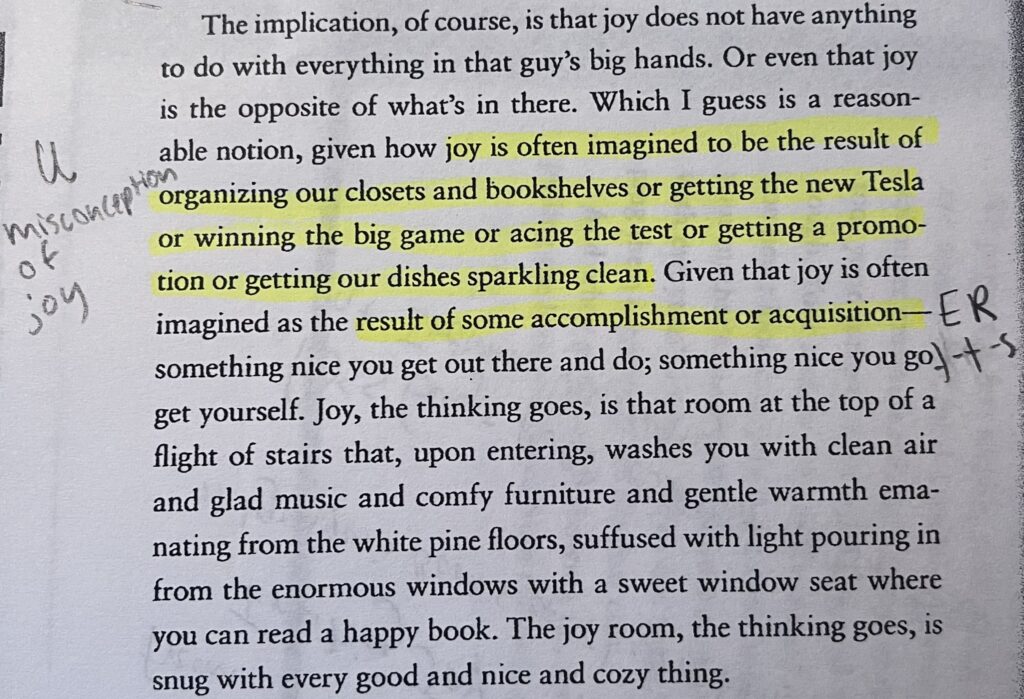
Annotation 2: Uses both Understanding and Text-to-Self annotations. I used the understanding annotation because I understood Zadie Smith’s example’s of pleasure that can be misconceived as joy. The text-to-self annotation was used because I can relate to the misconception of joy as an accomplishment or acquisition.
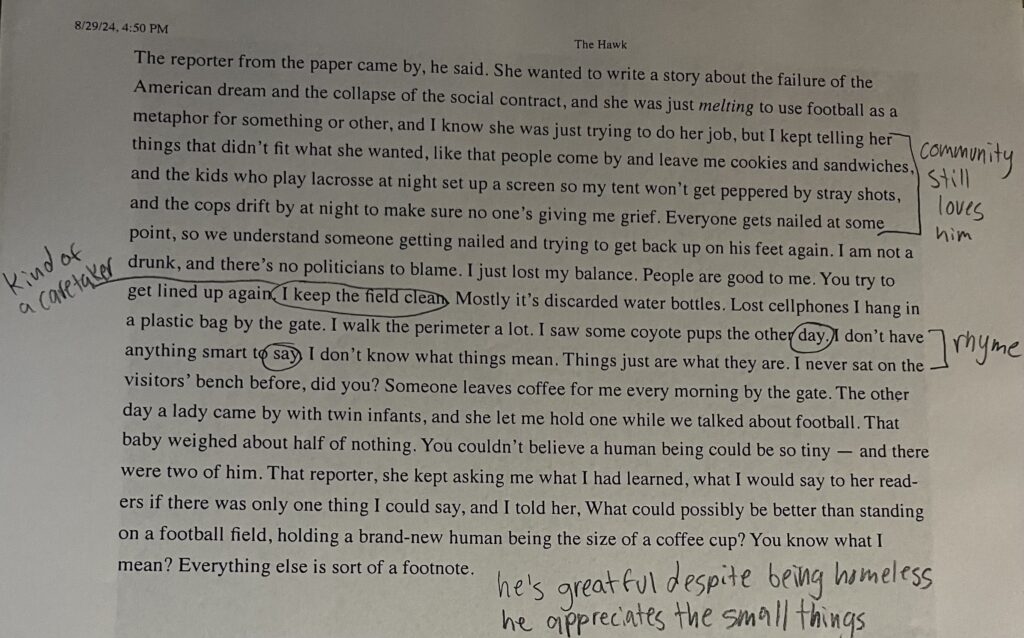
Early semester response answer to the “Hawk” offers very little analysis and lacks specifics.
Late semester response answer to “Joy”. I use a Barclay paragraph as well as specifics to answer the question thoroughly.

Learning Outcome 2 (Integrating Sources)

While integrating sources in the past I would simply quote the author to back up my claim, offering little to no explanation and analysis of the quote itself. This semester I have learned how to broaden my horizon by using the Barclay paragraph. A Barclay paragraph is basically a structured way of writing that helps you clearly make a claim, back it up with evidence, explain why that evidence matters, and tie it all together so your point actually lands. You can also use two different sources, creating a triangle of ideas between source #1, source #2, and yourself. Think of it as a conversation and you’re bouncing ideas off each other. Incorporating more than one source in your Barclay can make your argument deeper by showing the reader that your argument is a common conversation. By using my voice as well as voice from a source it makes my argument more compelling to the reader and backs up my own idea with credible information from experts. Using this structure forces me to show the connection between my point and the evidence, which makes my writing come across as more intentional and organized. Not only does this help the reader understand my argument better, but it also strengthens my confidence as a writer because I’m explaining my reasoning instead of hiding behind someone else’s words. I have found the Barclay formula incredibly useful while writing my two essays this semester, using it in both.

Barclay paragraph using two sources as well as my own voice. Creates a triangle between the two sources and myself making my argument compelling. This example shows a deeper understanding of how to incorporate sources in comparison to previous skill.

Learning Outcome 1 (Revision)

Over the course of the semester I have worked on revising my work in my essays as well as reading responses. I have focused both on global revision which is big picture stuff such as organization, paragraph structure, arguments, and evidence as well as local revision which is the way you manage your sentences to enhance specificity or clarity. When revising globally I have focused on making my argument narrow focused and backing it up with substantial evidence. Using sources we use in class to make my argument not only more compelling to the reader but to add some weight behind my claim. On the local level, I have spent time adding specificity to my work, in the past I have found my writing to be bland. With a lack of specifics in the past, and really wanting to improve on that this semester I have been asking myself during revision, Why? What? Who? Trying to give the reader more information for their minds to paint a picture of what I am trying to get across. Throughout this process, I’ve learned how much revision actually shapes the meaning of my writing. Small writing decisions like the way I frame a sentence or explain a detail can change how the reader understands my point. I’ve also realized that slowing down and re-reading my work with intention helps me catch habits I didn’t even notice before. Revision has become less of a chore and more of a chance to refine what I want to say and how I want to say it, making my writing clearer, stronger, and more purposeful.

Introduction paragraph in Joy essay. Thesis Statement before Thesis Workshop and local revisions. Lacks specificity to my argument.
Introduction paragraph after thesis workshop and local revisions. Added more specificity to my thesis statement and introduced the key players of the essay.

Essay #1 Reflection Questions

1.) What was your final thesis statement? Paste, then analyze its strengths & weaknesses in a focused paragraph (considering specificity, taking a stance, narrow focus, needing evidence to defend).

By tracing these similarities and incorporating other sources from the semester, I argue that empathy is not overrated and that its value depends on how consciously and deliberately we use it.

Overall, my thesis statement expresses the central idea that I am going to portray in my essay. However, I feel that I could have made it more specific. I think that by using both of the author’s claims right before and incorporating it into my thesis made it less specific and “I say”. I do take a clear stance on what I believe and by using both of the author’s ideas had a positive effect because it helped back up my thesis statement by using their ideas as evidence to support my claim. 

2.) In a separate paragraph, describe what you learned or were reminded of about your own writing process, from completing this essay. 

Throughout this essay I was reminded that structure and completing a rough draft is very important. By making a structure it allowed me as an author to express my ideas as efficiently and express them the way I wanted to. By using structure it allowed me to create a flow to my argument rather than having it be all over the place. Completing the rough draft was also important to my process, I found it beneficial to get feedback on how to bolster my argument and hit different criteria. Not only was it important to learn what I could improve on but by using my peer review of my partner I was able to see what they did well and apply some of their strengths to my own work. 

3.) In another paragraph: Which aspect of revision did you focus on most? What changes or adjustments made your essay stronger? Be specific. 

When revising my essay I really took each comment into account, I didn’t want to just dismiss what they were saying. One comment that I really took and ran with to revise my paper was expanding on relating my argument to myself and giving examples. Instead of having more “they say” I decided to implement what “I say”. Focusing on adding these things made my paper more balanced and backed up my argument. Rather than just stating my sources opinions, I expanded on their ideas and how they related to my life and real world occurrences. 

4.) How might you approach our next paper differently, from pre-reading and annotating, all the way through completion of your final draft? 

When annotating these next few readings I’m really going to focus on what point they are trying to get across. I feel that if I better understand their arguments it will make it easier for me to have a stance on where I am at in our next essay. With a deeper understanding of future author’s arguments I will be able to make my claim stronger and feel more natural to me.

DFW Reading Response

  1. In two healthy paragraphs, summarize the speech and show (with framed quotes and paraphrases from the text) what you believe to be the author’s three main points/arguments. Support with textual evidence and include your own initial response to the material.

The commencement speech, “This is Water”, by David Foster Wallace challenges the way we think on the surface level. Throughout his speech he challenges his listeners to use their liberal-arts college education to help them in life after school. Wallace says that a “liberal-arts education is not so much about filling you with knowledge as it is about teaching you how to think”. It can be easily misinterpreted at first, but if you dive deeper into his meaning, you come to find that he has a strong point that he is trying to get across. He wants us as listeners to challenge our “default thoughts”, and to take a step back and try to understand what is really in play. Wallace, when referencing annoying people at the store or long-lasting traffic after a long day of work, says, “If you’re automatically sure that you know what reality is, and you are operating on your default setting, then you, like me, probably won’t consider possibilities that aren’t annoying and miserable.” He is trying to say that the other people in this situation may be going through the same tribulations as himself, if not, worse.

I believe that he is also trying to say that we should have gratuity and that it is easy to get caught up overthinking instead of realizing what is right in front of us. I agree with Wallace when he says that we should have gratitude for what we have, and that if we chase certain things without stepping back we may always feel empty. At one point Wallace says, “If you worship money and things, if they are where you tap real meaning in life, then you will never have enough, never feel you have enough.” Despite wanting to achieve my goals in life and wanting to set myself up well, I can see what he means. Yes, it would be great to have boatloads of cash and multiple cars, but it’s important to be grateful for what you have and not get caught chasing more. Wallace also mentions it is easy to overanalyze and not step back and appreciate what is going on. This can apply to many facets of life. Personally, I moved on from a team in junior hockey that I really enjoyed. I liked my teammates, my billet family, and the location. I decided it was time for me to move up in competition, but with that I didn’t realize how much I would miss all the benefits of my old team. If I had taken a step back and thought harder through this decision I would have realized how much I had, and what I would be giving up. 

  1. Do you agree with DFW’s main arguments? Why or why not? Explain.

I strongly agree with DFW’s main arguments. I think it is important to control our thoughts, although it is sometimes difficult, I feel that if we can control our thoughts the majority of the time we would all benefit. It may prevent those thoughts that we find ourselves having by allowing us to take another look at what is actually going on. I found that Wallace was arguing against having a closed mindset and negative thoughts. Once again, sometimes uncontrollable, but he does a good job giving us tools to overcome these thoughts. The biggest tool I thought he gave his listeners was just to step back. It is easy to make impulse decisions or have impulse thoughts in the moment, but by taking a step back it can allow us to try to understand what is really happening.

  1. Do you believe DFW is referring to empathy, even though he never uses the word? Or is he hinting at something else?

While I don’t think Wallace is directly referring to empathy I think that what he said can be applied to using empathy. For instance, it could help us gauge whether someone is fishing for empathy or if they actually need it. Applying what he spoke about could also teach us when to use empathy, maybe someone doesn’t want or need it at the time. By taking a step back before making an impulse decision that may cause more harm, we can access what the person actually needs from us.

  1. Find one DFW quote that evoked a strong response. Paste the direct quote from his piece, then write a few sentences in which you challenge or support his statement.

“The most obvious, important realities are often the ones that are hardest to see and talk about.”

This quote really resided with me because you never know the full story behind someone. You may be quick to judge them for their appearance, attitude, or even their lifestyle decisions, but you don’t know the reasoning behind those behaviors. By giving them grace or even empathy for their behavior might be the right thing to do in certain situations. Not to act impulsively towards them and make their situation and yours worse. Using an act of empathy can go a long way in this case, whether it’s saying something kind, doing a kind gesture, or even doing nothing.

  1.  How do DFW’s main points interact with those of Paul Bloom (from our last reading)?

David Foster Wallace’s main points about controlling our “default setting,” stepping back to gain perspective, and showing gratitude for what we have fit in an interesting way with Paul Bloom’s arguments about empathy. Wallace argues that we should learn to think consciously and not get trapped in our default, selfish thoughts. This connects with Bloom’s analysis of empathy because Bloom suggests that empathy is not always the best tool for making fair or wise decisions. Both authors are asking us to resist reacting in the moment, whether it’s falling into negative thoughts (Wallace) or being swayed by selective empathy (Bloom) and instead choose a more thoughtful, deliberate approach to life and others.
Bloom Reading Response

  1. In two healthy paragraphs, summarize the piece AND show (with framed) quotes from the text) what you believe to be the author’s three main points/arguments. Support with textual evidence.

“Is Empathy Overrated” by Paul Bloom challenges not empathy but the morals around empathy. He doesn’t believe empathy is necessarily bad but rather the way it is distributed and applied to society. He believes that empathy has a narrow focus, making people focus on a single individual or group rather than the many others that need it. I think it relates back to what Konnikova was saying in “Limits of Friendship” about how you only have so much intellectual capacity to use when focusing on people. Relating empathy to the different layers of friends, people may drift away or completely fall out of your intellectual space, in this case out of your empathy spotlight. Bloom also believes that, “Empathy is limited as well in that it focuses on specific individuals” (2). He mentions that the support can even be overwhelming when the spotlight is focused on unordinary events that catch our eye and make us want to support. 

Bloom strongly believes that, “what really matters for kindness in our everyday interactions is not empathy but capacities such as self-control and intelligence and more diffuse compassion”(4). What he means in his final point is that if you take on other people’s suffering yourself, you may be less effective at supporting them in the long term, since reaching lasting goals often involves causing some short-term discomfort (Bloom 4). Overall, he makes many points about empathy being overrated but these three stuck with me and held the most value to my moral compass.

  1. Do you agree with Bloom’s main arguments? Why or why not?

I do agree with Bloom’s main arguments. I didn’t at first. I didn’t agree with his second point, “Further, spotlights only illuminate what they are pointed at, so empathy reflects our biases” (2). I didn’t believe that this was true because I believe that empathy is directed towards stories of hardship that are popular. I feel like not all stories are told, which keep these people who need help in the dark on the outskirts of the spotlight. However he followed it up with his third point combatting my opposed thoughts. He followed it up with, “Empathy is limited as well in that it focuses on specific individuals” (2). I took away that the media doesn’t highlight all stories because they only want to post or write up stories that drive numbers. By trying to relate the stories they push to the people we know and love.

  1. In what ways does Bloom challenge your initial understanding or perception regarding empathy?

Bloom challenges my initial perception of empathy. I’ve known of empathy and how it impacts those in need, but I did not understand that there are so many people that need it. By showing the reader that empathy is indeed important but telling us we are using it wrong, Paul Bloom is stoking the discussion and spreading awareness about how we can improve the ways we use empathy as a society.

  1. Find one claim Bloom makes that evoked a strong response. Paste the direct quote from his piece, then write a few sentences in which you challenge OR support his claim in your own words and experience(s).

“it’s far easier to empathize with those who are close to us, those who are similar to us, and those we see as more attractive or vulnerable and less scary” (Bloom 2)

After quoting this he then brings in race. I feel like personally when I give empathy towards a person it doesn’t matter their race. I am more inclined to show empathy towards someone who makes me feel comfortable. Like giving money to homeless people, if they are bent over and have scabs on them I may feel scared so I feel that I don’t show them as much empathy as I would to a homeless person with a smile on their face and somewhat put together. I am not saying that the person bent over covered with scabs doesn’t deserve empathy, but I would definitely feel uncomfortable helping them out. I feel that race isn’t a driving factor when I am giving out my empathy.

  1. Jot down one specific discussion question (related to the reading) and bring to class to help spark conversation

According to Bloom, it is easier for us to empathize with those who are close and similar to ourselves. Does this mean empathy is shared equally in society as there is a variety of people, or do you think empathy is disproportionately shared among society due to social classes and what society deems as commonly shared characteristics and values?

As Bloom claims we are more likely to empathize with others we relate to, this is a mirror of our own experiences and values. When we can’t relate to others pain and can’t empathize with someone because of their appearance and differences, does this cause an empathy deficit in certain populations in society and if so how can we help reduce this or is this lack of empathy for certain populations something worth addressing?

First Writing Project

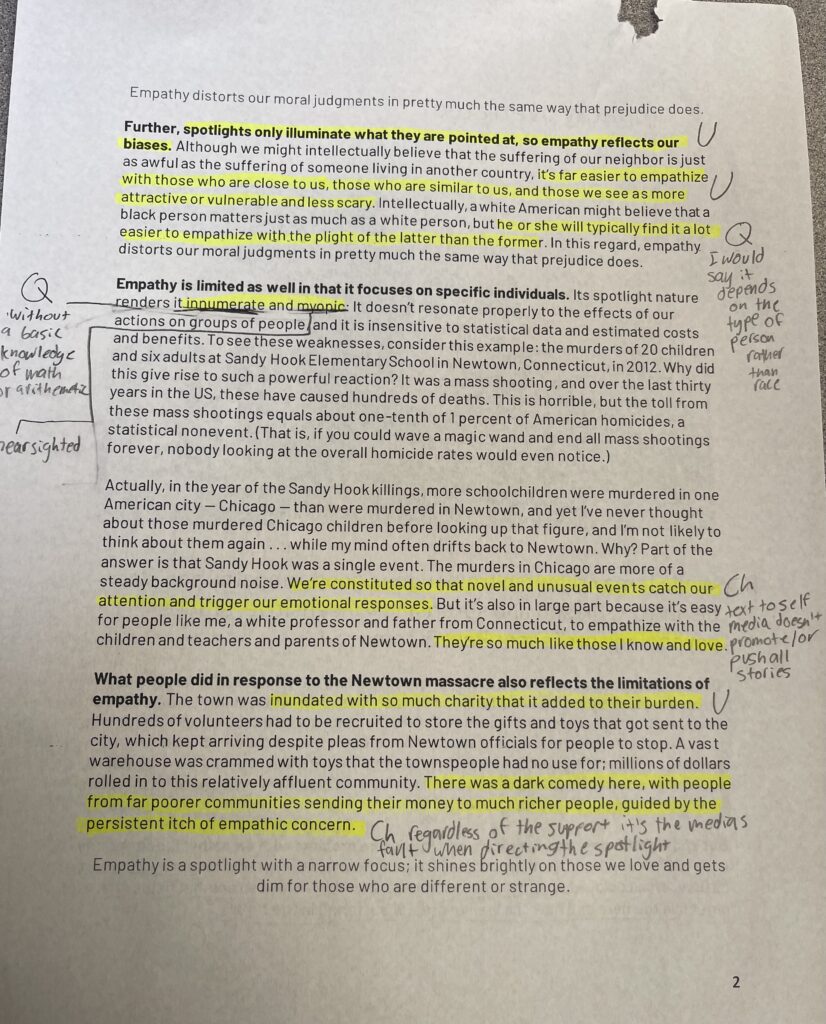
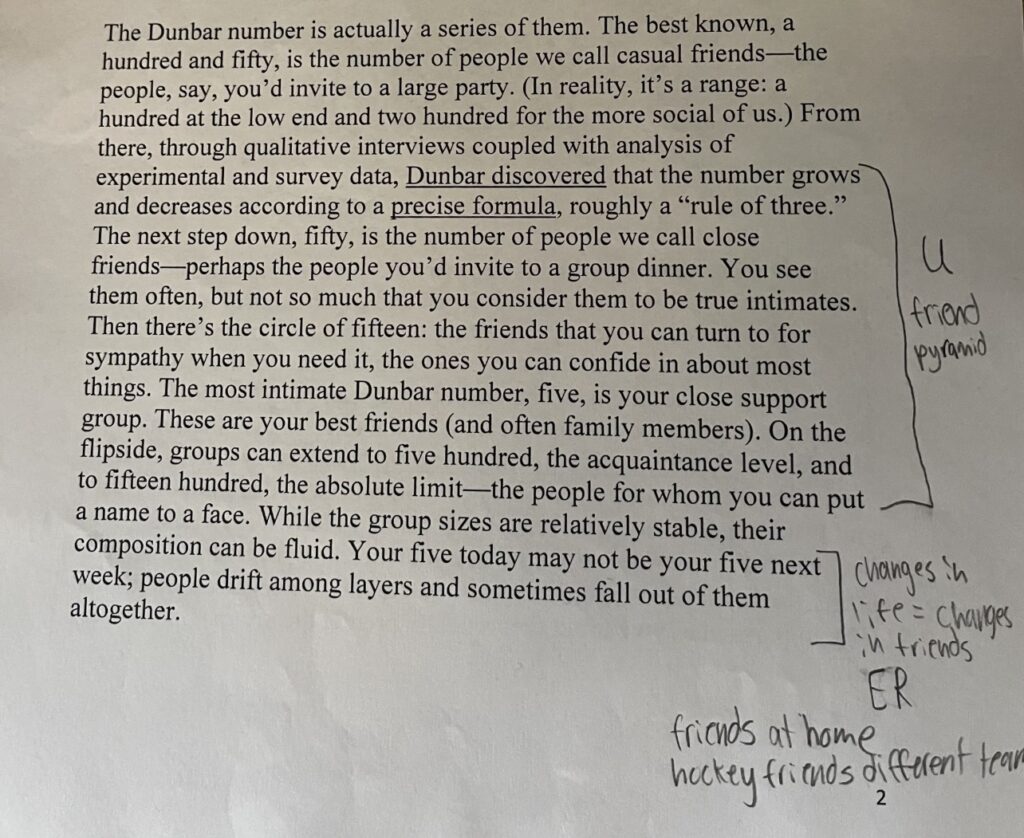
Over the course of the first few weeks one may notice a positive difference in my ability to annotate, use source integration, preview readings, and write responses to them. We have done some start up activities that reminded me of ways to expand on my reading responses and go into depth using personal reflection. At first in “The Hawk” by Brian Doyle my annotation skills and reading responses were surface level as we moved forward to “The Limits of Friendship” by Maria Konnikova I had broadened my horizon. Taking a look at my annotations in “The Hawk” and comparing them to mine in “The Limits of Friendship” I noticed that at first I would just highlight quotes I found interesting or occasionally highlight ones I had questions about. Maybe I would write a quick note in the margin every so often about something I noticed, whether it be about character development or the basis of the setting. I believed I was annotating well. I then began to utilize the exploring relationships annotation. The annotation style resided with me. Allowing myself to dive deeper into the reading and grow interest in the topic even though it might not have been the most entertaining to me. By relating myself to text I was able to relate myself to the author. For example in one of my responses to Konnikova’s text I wrote, “For instance my current roommate right now, I grew up playing hockey with him and he’s from North Carolina. Being able to maintain a relationship with him through social media and seeing him periodically at the rink I was able to get one of my friends to be my roommate.” By using text-to-self annotation I was able to relate myself to what Konnikova was expressing in her writing even though I was disagreeing with her I was able to connect on a deeper level than if I were to just skim the reading and mark what I found interesting. 

Comparing annotations between “The Hawk” and “The Limits of Friendship”

“The Hawk” top picture / “The Limits of Friendship” bottom picture

Integrating sources in your writing is a great way to back up your ideas with those of experts, whose words hold value in the subject. When writing an argumentative piece you can be entitled to your own opinion, but why does the reader care what your opinion is? You have to make your work credible by doing research to bolster your claim. Pointing out how I agreed with Konnikova when she wrote, ““Your five today may not be your five next week; people drift among layers and sometimes fall out of them altogether” (2). Then by backing up her claim with an example of how my friends have changed because of my change in lifestyle. Instead of making my claim by itself without integrating a source, I found an improvement in my writing by using one. It helped me support my claim and keep the reader involved. Integrating a source will keep the reader involved or maybe even sway their opinion.

using source integration to help with 300 word writing assignment

When previewing texts I found that I tend to immediately put down the reading almost immediately due to the lack of interest. Now I am able to keep that reading in hand and dive deep into its words. All because of my new found kill of previewing. Reading the title, author’s name or even seeing an illustration on the cover, I am able to draw interest before I have even started reading. Being able to allude to what the title means, research the author to learn their credibility, and analyze a picture has done wonders for me. It began my interest, after learning the skill I applied it to the reading of “The Limits of Friendship”. I immediately searched up Konnikova and saw that she was a poker player and podcaster, both of which I like. I was then interested in what she had to offer me as a reader. Over these first few weeks I have felt that my experience as a writer as well as a reader have improved and I am excited for the rest of the semester to see how much I can grow.

« Older posts
css.php