Month: November 2025

Learning Outcome 4 (Peer Review)


Peer review has been extremely beneficial to my final drafts of essays. Unlike my peer review in high school which focused on grammatical errors and sentence structure, peer review in college helps with ways to make your essay better by using global revision which is big picture stuff such as organization, paragraph structure, arguments, and evidence as well as local revision which is the way you manage your sentences to enhance specificity or clarity. When reviewing with my peers this semester I was offered to bolster my argument like adding more specificity to an example, making my thesis statement clearer, or adding more analysis after a quotation. Having someone to work with wasn’t only beneficial because of the comments they left on my essays but by being able to read their work I was able to see what worked well for them and tweak their style into my own essay. Whether it was their play on words or their uses of examples to pull me in, I feel that a lot of the growth I have undergone this semester has been through peer review. It pushed me to slow down, rethink why certain choices mattered, and become more intentional with how I present my ideas. It also helped me see my writing from a reader’s perspective, which made my revisions more purposeful and less about fixing mistakes and more about shaping meaning. Overall, peer review has become one of the most important tools in improving how I write and how I think about writing.
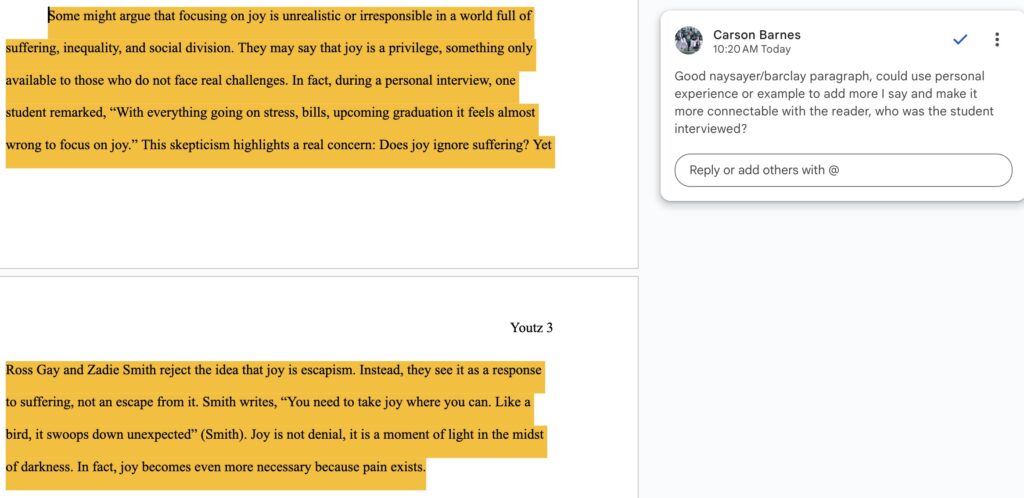
Comment left on my peer’s essay to inspire more I say. The peer did a good job using sources to create their Barclay/Naysyayer paragraph but I felt they need to include their own voice to make it more compelling.
End Comment left for my peer during the Joy essay peer review session. By giving a brief overview on what I thought they did well and gave them my own insight on what they could improve on I feel as I was able to set them up to improve on their essay as well as boost their confidence on what they did well.

Learning Outcome 3 (Reading + Annotations)

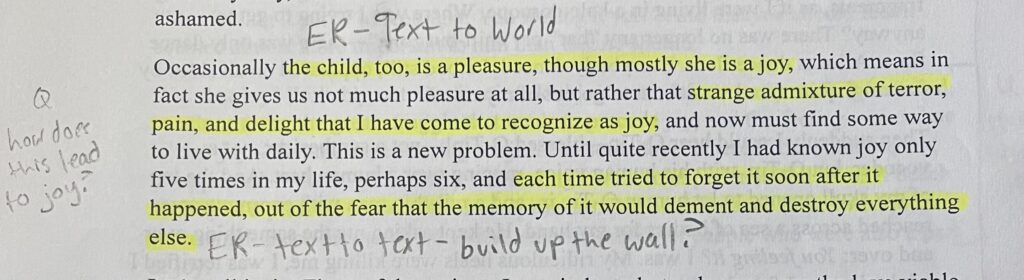
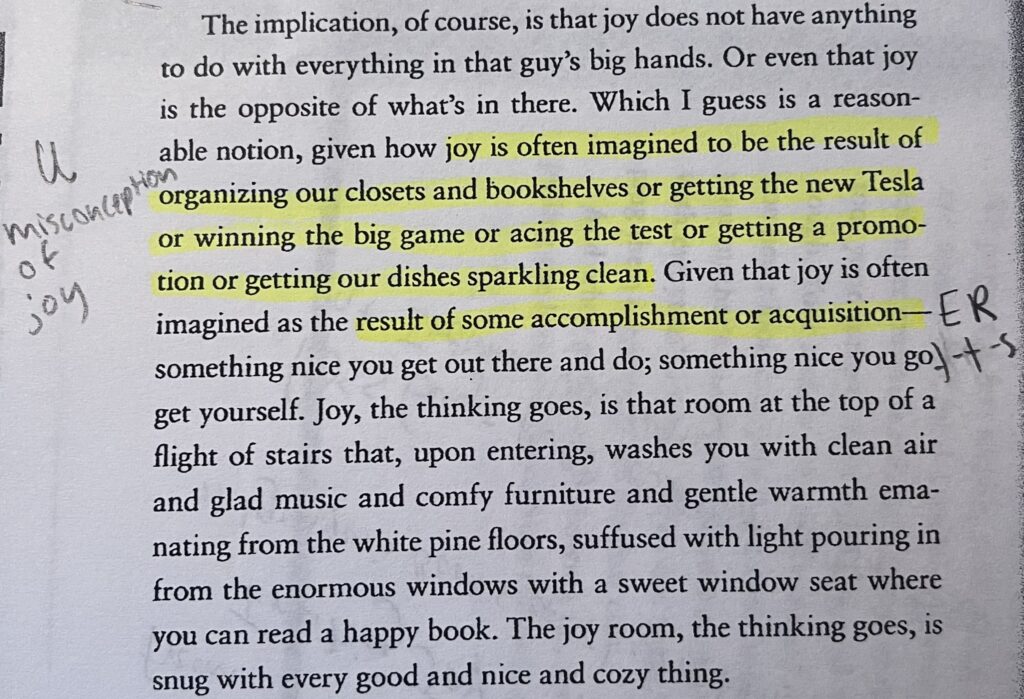
Revisiting my responses from “The Hawk” by Brian Doyle and “Joy” by Zadie Smith, I was disappointed and pleased with myself. Why both? You might ask. Well I am disappointed in the way I used to answer questions, clearly lacking specificity. I would answer the questions with a summary rather than analyzing the questions and using my own voice. However, I am pleased with how far I have come since then. More recently, my answers in response to “Joy” offer more detail and analysis of the piece. Answering the questions with my own voice and quotes from the source, rather than a brief summary. During the first essay it was difficult to gather my ideas to support my argument, but by writing in more detail and using critical thinking in my responses I was able to transfer over some of my ideas easier during the second essay. Not only have I noticed a difference in my responses but I have developed my annotation skills tremendously. Annotation being a key difference in my writing process between essay one and two. When I first began with Becoming a Writer, I would circle or write in the margin when I noticed something, causing my annotations to not be scattered all over the place. Now, after learning about different annotation styles such as understanding, rhetorical, questioning, and exploring relationships, I am able to think more critically about what I am reading. Using those annotation styles allows me as a reader to bookmark key information for reading responses and contribute more to class discussions.

Annotation 1: Uses both Text-to-World and Text-to-Text annotations to explore relationships. The text-to-world annotation is used when I recognized how a child brings joy to many families in our world. The text-to-text is used when I noticed a similarity to Brian Doyles idea of “building up a brick wall”. Uses questioning annotation to bring up in class: How the paragraph leads to joy?
Annotation 2: Uses both Understanding and Text-to-Self annotations. I used the understanding annotation because I understood Zadie Smith’s example’s of pleasure that can be misconceived as joy. The text-to-self annotation was used because I can relate to the misconception of joy as an accomplishment or acquisition.
Early semester response answer to the “Hawk” offers very little analysis and lacks specifics.
Late semester response answer to “Joy”. I use a Barclay paragraph as well as specifics to answer the question thoroughly.

Learning Outcome 2 (Integrating Sources)

While integrating sources in the past I would simply quote the author to back up my claim, offering little to no explanation and analysis of the quote itself. This semester I have learned how to broaden my horizon by using the Barclay paragraph. A Barclay paragraph is basically a structured way of writing that helps you clearly make a claim, back it up with evidence, explain why that evidence matters, and tie it all together so your point actually lands. You can also use two different sources, creating a triangle of ideas between source #1, source #2, and yourself. Think of it as a conversation and you’re bouncing ideas off each other. Incorporating more than one source in your Barclay can make your argument deeper by showing the reader that your argument is a common conversation. By using my voice as well as voice from a source it makes my argument more compelling to the reader and backs up my own idea with credible information from experts. Using this structure forces me to show the connection between my point and the evidence, which makes my writing come across as more intentional and organized. Not only does this help the reader understand my argument better, but it also strengthens my confidence as a writer because I’m explaining my reasoning instead of hiding behind someone else’s words. I have found the Barclay formula incredibly useful while writing my two essays this semester, using it in both.

Barclay paragraph using two sources as well as my own voice. Creates a triangle between the two sources and myself making my argument compelling. This example shows a deeper understanding of how to incorporate sources in comparison to previous skill.

Learning Outcome 1 (Revision)

Over the course of the semester I have worked on revising my work in my essays as well as reading responses. I have focused both on global revision which is big picture stuff such as organization, paragraph structure, arguments, and evidence as well as local revision which is the way you manage your sentences to enhance specificity or clarity. When revising globally I have focused on making my argument narrow focused and backing it up with substantial evidence. Using sources we use in class to make my argument not only more compelling to the reader but to add some weight behind my claim. On the local level, I have spent time adding specificity to my work, in the past I have found my writing to be bland. With a lack of specifics in the past, and really wanting to improve on that this semester I have been asking myself during revision, Why? What? Who? Trying to give the reader more information for their minds to paint a picture of what I am trying to get across. Throughout this process, I’ve learned how much revision actually shapes the meaning of my writing. Small writing decisions like the way I frame a sentence or explain a detail can change how the reader understands my point. I’ve also realized that slowing down and re-reading my work with intention helps me catch habits I didn’t even notice before. Revision has become less of a chore and more of a chance to refine what I want to say and how I want to say it, making my writing clearer, stronger, and more purposeful.

Introduction paragraph in Joy essay. Thesis Statement before Thesis Workshop and local revisions. Lacks specificity to my argument.
Introduction paragraph after thesis workshop and local revisions. Added more specificity to my thesis statement and introduced the key players of the essay.

css.php