Over the course of the first few weeks one may notice a positive difference in my ability to annotate, use source integration, preview readings, and write responses to them. We have done some start up activities that reminded me of ways to expand on my reading responses and go into depth using personal reflection. At first in “The Hawk” by Brian Doyle my annotation skills and reading responses were surface level as we moved forward to “The Limits of Friendship” by Maria Konnikova I had broadened my horizon. Taking a look at my annotations in “The Hawk” and comparing them to mine in “The Limits of Friendship” I noticed that at first I would just highlight quotes I found interesting or occasionally highlight ones I had questions about. Maybe I would write a quick note in the margin every so often about something I noticed, whether it be about character development or the basis of the setting. I believed I was annotating well. I then began to utilize the exploring relationships annotation. The annotation style resided with me. Allowing myself to dive deeper into the reading and grow interest in the topic even though it might not have been the most entertaining to me. By relating myself to text I was able to relate myself to the author. For example in one of my responses to Konnikova’s text I wrote, “For instance my current roommate right now, I grew up playing hockey with him and he’s from North Carolina. Being able to maintain a relationship with him through social media and seeing him periodically at the rink I was able to get one of my friends to be my roommate.” By using text-to-self annotation I was able to relate myself to what Konnikova was expressing in her writing even though I was disagreeing with her I was able to connect on a deeper level than if I were to just skim the reading and mark what I found interesting.
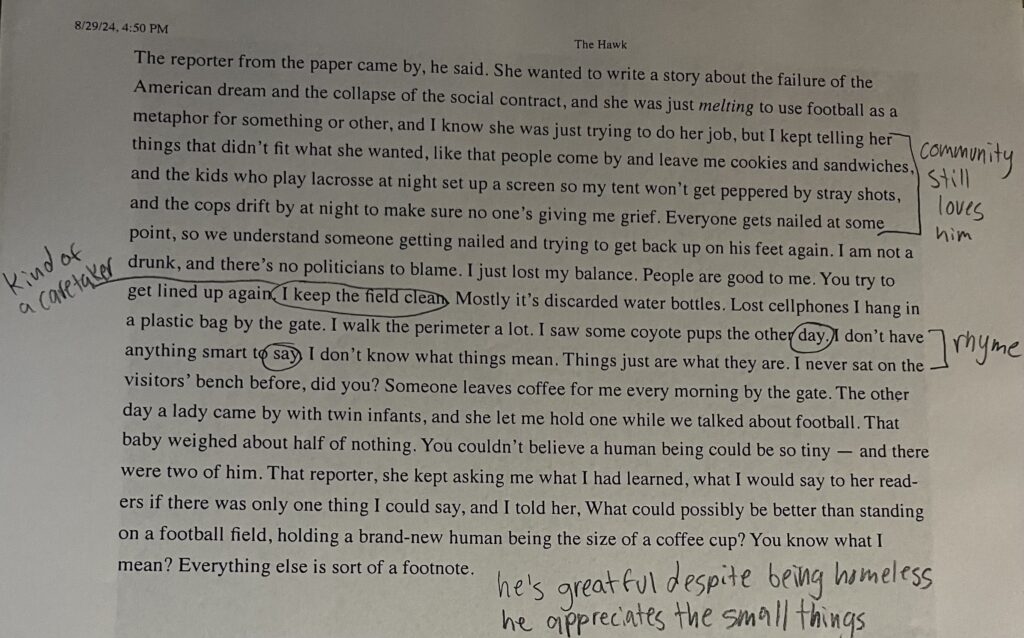
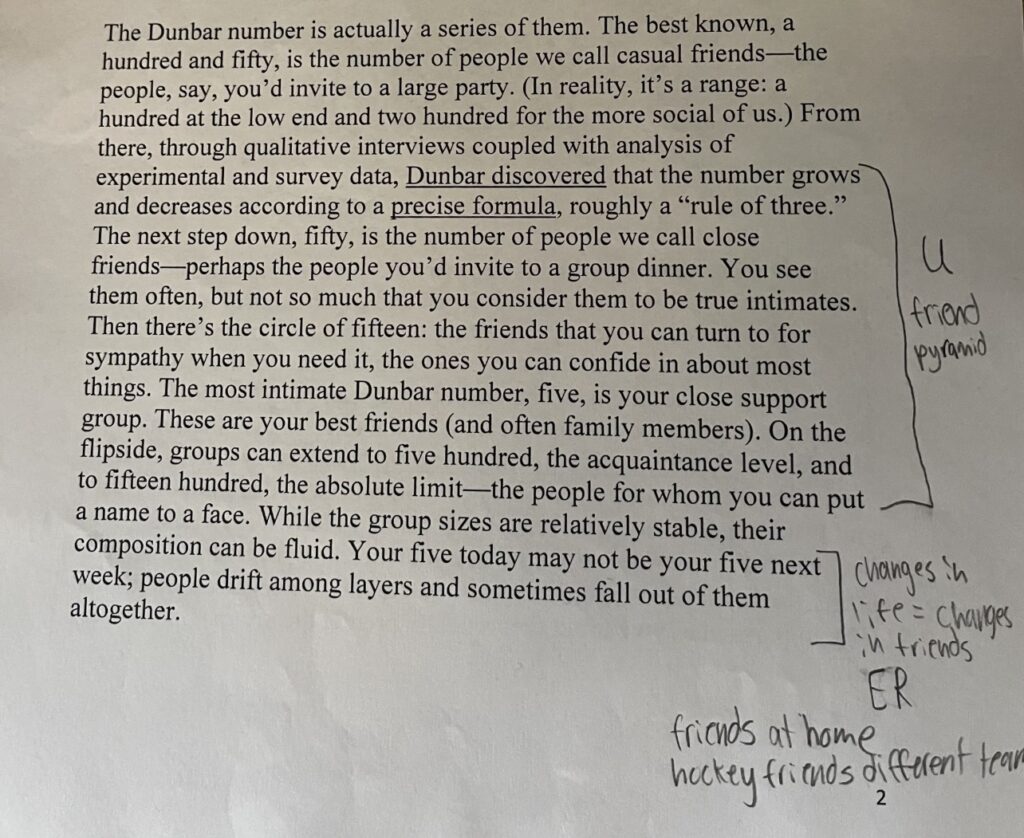
Comparing annotations between “The Hawk” and “The Limits of Friendship”
“The Hawk” top picture / “The Limits of Friendship” bottom picture
Integrating sources in your writing is a great way to back up your ideas with those of experts, whose words hold value in the subject. When writing an argumentative piece you can be entitled to your own opinion, but why does the reader care what your opinion is? You have to make your work credible by doing research to bolster your claim. Pointing out how I agreed with Konnikova when she wrote, ““Your five today may not be your five next week; people drift among layers and sometimes fall out of them altogether” (2). Then by backing up her claim with an example of how my friends have changed because of my change in lifestyle. Instead of making my claim by itself without integrating a source, I found an improvement in my writing by using one. It helped me support my claim and keep the reader involved. Integrating a source will keep the reader involved or maybe even sway their opinion.

using source integration to help with 300 word writing assignment
When previewing texts I found that I tend to immediately put down the reading almost immediately due to the lack of interest. Now I am able to keep that reading in hand and dive deep into its words. All because of my new found kill of previewing. Reading the title, author’s name or even seeing an illustration on the cover, I am able to draw interest before I have even started reading. Being able to allude to what the title means, research the author to learn their credibility, and analyze a picture has done wonders for me. It began my interest, after learning the skill I applied it to the reading of “The Limits of Friendship”. I immediately searched up Konnikova and saw that she was a poker player and podcaster, both of which I like. I was then interested in what she had to offer me as a reader. Over these first few weeks I have felt that my experience as a writer as well as a reader have improved and I am excited for the rest of the semester to see how much I can grow.

Leave a Reply